
Best Capsule Slip Rings for Seamless Rotary Motion Applications
2026-08-07
In high-speed, space-constrained rotary systems, signal integrity and uninterrupted power transmission are non-negotiable. Capsule slip rings have emerged as the go-to solution for compact, reliable performance—and among the top contenders, MOFLON stands out for its engineering precision and application versatility. Whether you're designing a miniature surveillance drone or a high-cycle automated test rig, choosing the right slip ring can make or break your project. In this post, we cut through the noise to reveal the best capsule slip rings that truly deliver seamless rotation.
What Puts Capsule Slip Rings at the Core of Smooth Rotary Motion
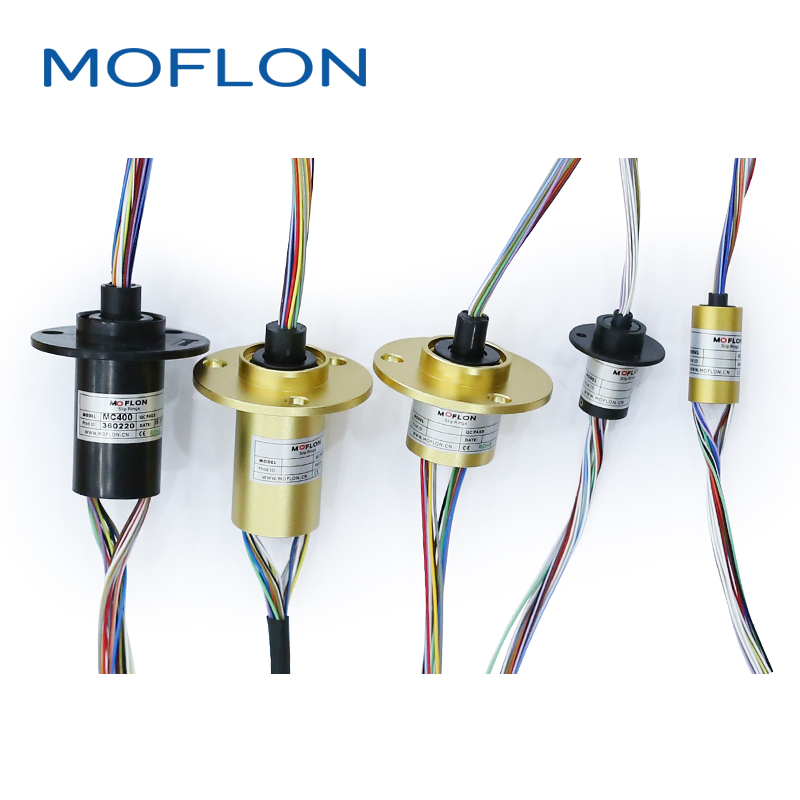
In any system where rotation is continuous and space is at a premium, the capsule slip ring ends up doing the heavy lifting. Unlike larger through-bore designs, its compact cylindrical form slides neatly into the heart of an assembly without demanding major redesigns. That small footprint isn’t just about saving room—it’s about placing the electrical pathway exactly where it’s needed, eliminating awkward wire routing that can snag, fatigue, or cause torque ripple. Every turn feels seamless because the internal ring-and-brush stack is purpose-built to maintain contact pressure silently, even when speeds climb or the mounting orientation shifts.
What often gets overlooked is how the capsule slip ring tames mechanical noise before it ever becomes an issue. Inside that sealed housing, precision-ground rings and multi-finger brushes create a wiping interface that doesn’t rely on heavy spring force. The result is far less micro-fretting than you’d find in older slip ring styles—meaning lower electrical resistance fluctuations and a cleaner signal path for sensitive sensor data. It’s the kind of detail that doesn’t show up on a spec sheet, but becomes immediately obvious when your rotary joint spins day after day without that telltale crackle in an audio feed or a glitch in a video stream.
Beyond just passing current, a well-designed capsule slip ring lets engineers forget about the articulation point entirely. Once it’s integrated, there’s no need for scheduled lubrication, constant tension adjustments, or the creeping worry that a hard turn limit might be approaching. That durability frees designers to push rotation speeds higher and pack more circuits into the same envelope—whether it’s for a surgical robot needing haptic feedback at full rotation or a radar pedestal that can’t afford a single dead spot. The capsule form factor turns what used to be a maintenance headache into a silent, enduring partner that sits right at the pivot of motion and simply works.
Keeping Signals Clean When Every Degree of Rotation Counts
In precision motion systems, even the tiniest stray signal can cascade into a positioning error that scraps a part or skews a measurement. Rotary encoders and resolvers, the unsung heroes behind robotic arms and telescope drives, must deliver feedback free from noise and harmonic distortion. When you're chasing sub-arcsecond accuracy, shielding cables and twisting differential pairs isn't just good practice—it becomes a survival skill for your signal integrity.
Many engineers overlook how ground loops and common-mode noise sneak in through seemingly innocent mounting hardware. A resolver's stator rigidly bolted to a motor housing may create a galvanic path that hums with inverter switching frequencies. Breaking that loop with insulating bushings, or opting for a capacitively coupled encoder interface, often rescues the last few microradians of jitter that eat into your control margin.
Beyond the cabling, the real subtlety lies in synchronizing the excitation and sampling windows. When the resolver's carrier gets sampled a few nanoseconds early or late, the demodulated angle picks up a phantom ripple that grows with speed. Tightening the timing, temperature-compensating the filters, and treating every millidegree as a precious commodity transforms a regular feedback loop into a high-fidelity channel that truly respects the physics of rotation.
The Overlooked Factors That Make or Break a Capsule Slip Ring Pick
Most engineers fixate on ampacity and circuit count, but real-world performance hinges on how the capsule slip ring handles environmental stress. Tiny fluctuations in humidity, stray dust, or thermal cycling can silently degrade contact resistance, turning what looked like a solid data link into a source of intermittent glitches. Over time, oxidation and wear particles build up in the ring grooves, causing micro-dropouts that are nearly impossible to trace.
Another factor that rarely makes the checklist is breakaway torque and running smoothness. In high-precision applications, even a minor spike in rotational drag can translate into vibration that wrecks alignment or introduces noise in sensitive signals. The difference between a whisper-quiet unit and one that hums with mechanical chatter often comes down to the wire lubricant and the geometry of the brush contacts—details that don’t show up on a standard datasheet.
Integration headaches are just as underrated. A slip ring might meet every electrical spec but still fail because its lead exit direction conflicts with the available space, or because the connector style forces awkward routing that picks up EMI. And once it’s buried deep inside a rotating assembly, swapping out a unit that wasn’t built for field servicing can turn a ten-minute adjustment into a full teardown. Missing these practical bits during selection isn’t just inconvenient—it can silently cap the reliability of the whole system.
Where Compact Slip Rings Stand Out in Day-to-Day Equipment
You might not realize it, but compact slip rings are quietly powering some of the most routine devices around you. Take that revolving door at your office building—the smooth rotation relies on a tiny slip ring to pass electrical signals and power between the stationary frame and the spinning wings. Without it, those doors would be a tangled mess of wires or, worse, completely static. From coffee grinders to electric toothbrushes, these miniature components handle the continuous rotation that makes daily life a little more effortless, often tucked away inside housings so small you’d never spot them.
Medical equipment is another space where compact slip rings truly shine, though patients rarely see them in action. Inside a CT scanner, a slip ring transfers high-speed data and power as the gantry spins around the body, enabling crystal-clear cross-sectional images without messy cable management. Even something as simple as a dental handpiece uses a slip ring to deliver power to the burr while spinning at thousands of rotations per minute. The real feat is how these rings maintain reliable connections in such tight, sterile environments—no slippage, no interference, just consistent performance when it matters most.
What sets compact slip rings apart is how they sneak into consumer gadgets without adding bulk or complexity. Consider a rotating display stand at a mall or a panoramic camera that captures 360-degree timelapses: both depend on these rings to avoid wire twisting. In robotics toys and kitchen appliances, custom miniature designs keep things sleek while handling everything from low-voltage sensor data to higher-current motor power. It’s the kind of invisible engineering that lets designers push the boundaries of movement, all by solving a problem most of us never knew existed.
Stories from the Field: Durability Myths and Real-World Wear
You hear it all the time: “Buy this brand, it lasts forever.” But after a year of hauling gear across rocky trails, the seams start to fray. The myth of indestructible outdoor equipment crumbles fast when you’re miles from the trailhead, patching a torn pack with duct tape and hope. Real-world wear doesn’t care about marketing claims—mud, sun, and sweat find every weak spot.
I once met a thru-hiker who swore by a lightweight tent that online forums worshiped. By day 40, the zippers were jammed, the floor had more holes than mesh, and the poles splintered in a mild wind. He laughed it off, saying the only thing durable was his memory of the price tag. In the field, durability isn’t about surviving a lab test; it’s about enduring the chaotic, unscripted abuse of daily adventure.
Then there’s the opposite story: gear that looks flimsy but surprises you. A friend’s decade-old rain jacket—cheap, thin, no fancy membrane—still beads water like day one. It’s been through downpours in Patagonia and bushwhacks in the Adirondacks, and it refuses to quit. These stories remind us that durability isn’t a spec sheet. It’s the quiet persistence of something that just works, long after the hype fades.
Long-Haul Performance: Simple Installation and Upkeep Practices
Getting optimal long-haul performance from your gear isn't about complex procedures—it's about nailing the basics. A clean, methodical setup from day one prevents most headaches down the road. Double-check torque specs, align components with patience, and don't skip the seemingly minor steps like proper cable routing. These upfront efforts pay dividends in reliability when you're miles from the nearest service center.
Upkeep routines often get overcomplicated. Stick to a short, consistent checklist: wipe down seals, inspect critical fasteners, and lubricate sparingly but regularly. The goal is to catch wear before it forces a roadside repair. Tune your maintenance schedule to actual usage patterns rather than generic intervals, and you'll extend component life without wasting time on unnecessary tasks.
There's also a human factor that manuals overlook—develop a feel for your equipment. Subtle changes in sound, vibration, or response often signal impending issues. Combining that intuition with straightforward, no-frills care turns routine upkeep into a habit, not a chore, and keeps your setup performing as intended over thousands of miles.
FAQ
A capsule slip ring is a compact, integrated unit that transfers power and signals from a stationary part to a rotating assembly. It uses sliding contacts inside a small housing, eliminating cable twisting and allowing 360-degree continuous rotation without interruptions.
Capsule slip rings are typically smaller, lighter, and more cost-effective for low-current signal and power transmission. They excel in tight spaces where traditional rotary joints are too bulky or over-specified, such as in CCTV cameras or small robotic arms.
Look for gold-gold contacts for reliable low-noise signal transfer, a robust shielded design to prevent interference, a life rating of at least 10 million revolutions, and a compact form factor that fits effortlessly into your rotating assembly.
They are ideal for medical imaging scanners, pan-tilt security cameras, wind turbine pitch controls, packaging machinery, and exhibit displays—anywhere continuous rotation must combine clean signal paths with minimal maintenance.
Start by listing all the circuits you need—power, Ethernet, USB, or analog signals. Then check the slip ring's specification for rated current per circuit and bandwidth. Always allow a safety margin of about 20% above your maximum expected load.
Yes, quality units maintain stable contact at speeds up to 250–300 rpm. Above that, you might need custom engineering, but for most camera and automation tasks, standard models deliver jitter-free performance if properly installed.
Secure both the rotor and stator without over-stressing the leads. Avoid lateral forces on the housing during mounting, keep the area dust-free, and route the wires with a gentle service loop so that rotation doesn't tug on the connections.
The most frequent mistake is ignoring the exact circuit configuration—mixing power and sensitive data lines on a single slip ring without proper separation can cause noise. Also, exceeding the recommended running torque may lead to premature wear, so always verify mechanical compatibility.
Conclusion
In precision rotary systems, the right capsule slip ring does much more than pass power and data—it anchors the entire motion chain. At the heart of smooth, uninterrupted rotation, these compact components maintain electrical continuity while canceling out the micro-fluctuations that can throw off sensitive signals. High-quality units keep signal paths clean even at full speed, suppressing noise and contact bounce so that every degree of rotation transmits data as clearly as at rest. What truly separates a dependable slip ring from a headache waiting to happen often comes down to overlooked details: contact material pairing, brush pressure consistency, and housing design that handles thermal expansion without binding. When those elements align, the result is silent, near-frictionless performance that makes motion feel effortless.
Day-to-day equipment reveals where compact slip rings genuinely shine—inside packaging machines, medical scanners, and robotic joints where space is tight but reliability is nonnegotiable. Field experience consistently debunks the myth that capsule slip rings wear out quickly; properly sealed units shrug off dust, moisture, and light debris, lasting far longer than many engineers assume. Real-world wear patterns show that failures usually trace back to installation mishaps or neglected bearings rather than the slip ring itself. The best long-haul performers share a common trait: their design simplifies installation and upkeep. Snap-in mounting, pre-aligned brushes, and tool-free access panels cut hours of labor while preventing the misalignment that leads to early failure. A quick wipe of the ring surface and an occasional check of lead freedom are often all that’s needed to keep them running year after year, turning a potential maintenance headache into a set-and-forget advantage.
Contact Us
Contact Person: Xiangpin Li
Email: [email protected]
Tel/WhatsApp: 86 186 1706 8578
Website: https://www.moflon.com